Now we will talk about Forex marketing. There is a business opportunity available that can cost very little to set up, and can be run by dedicating as little as one hour per day to it. This phenomenal business opportunity can earn you six figure annual profits, and your income will never be affected by a recession.
What is this incredible business opportunity? Well currency trading of course, and it can be done from the comfort of a computer (preferably a laptop) with an Internet connection. If a home based business is what you're looking for, trading the Forex market in my opinion, is the best business model to pursue.
While the ideal amount of money to start trading currency with is $2,000.00, one can start with a mere $200.00 and have the ability to leverage their trading at a rate of 100 to 1, making it possible to trade $20,000.00 worth of currency. After you've completed your first trade, simply take your profit earned off of your $200.00 investment, and put in another trade by reinvesting the full amount (principle+profit). This process can be repeated over an over again in order to build capital, until you reach a level of capital investment that you are comfortable with. You can then simply withdraw your profits and continue to reinvest your principle.
Among the many advantages that this business provides, it is truly protected from recession simply because of the fact that as one currency rises, another currency falls. Likewise as one currency falls, another one rises. Trading the Forex market can be done from virtually anywhere in the world where an Internet connection is available. Just pick up your laptop and go! You have no boss to answer to and you have the ability to take vacations whenever you please. The potential gains that can be made through Forex trading are absolutely outstanding. This is a business that truly has the ability to put you in complete control of your financial destiny.
One of the first questions that many aspiring traders have about this business is "how easy is it to learn"? Well the best way to answer that is by giving an example. About 24 years ago, in 1983, long before the Internet as we know it first came about, a trader by the name of Richard Dennis took it upon himself to teach a fine group of every day people like you and me, how to trade. These men and women had never traded the financial markets and he was able to have them completely taught in a mere 14 days. Two weeks! Of course it would take practice before they were trading the markets successfully in a consistent manner, but they had all the basic knowledge that they needed in order to do so. This group of traders went on to earn a collective 100,000,000 dollars! Some of them eventually became some of the most famous traders in all of history!
The fact of the matter is that trading currency, or really any financial instrument, can be learned by absolutely anyone of average intelligence who is willing to put in the time and effort. Is every aspiring trader going to eventually make millions? I would venture to say probably not, simply because it is likely that not everyone will take the steps necessary to reach such a lofty goal. However if one does take the necessary steps, I see no reason why they cannot achieve millionaire status. It is simply a process and consistency is the key, especially in the Forex market where the effort required to achieve great rewards, is really very minimal in comparison to some of the other markets.
More specifically, the real key to success in the business of trading currency is working with leverage. For example, leveraging your money with a deposit of $500.00, gives you that ability to trade with $50,000.00. This degree of leverage greatly magnifies both your gains and your losses. Your degree of success will be determined by how well you learn to effectively deal with leverage, and this is definitely a market where practice makes perfect!
Generally speaking, the best way to trade the Forex market is by following chart patterns that repeat themselves, using these patterns as your guide. The engine that drives the activity on these charts are trends in the world economy, which in turn affects or more specifically actually is, the currency market.
Thursday, April 30, 2009

Forex Business Plan
Today we will talk about Forex Busines Plan. Whether you are planning to start a brand-new business, expand an existing company, or get financing for a business venture, you will need to write a business plan. A business plan not only lends your business a sense of credibility, but also helps you to cover all your bases, increasing your chances of success.
Although writing a business plan can be a lengthy, intimidating project, it is not necessarily difficult. Here is an overview of how to write a successful business plan.
What to Include in Your Business Plan
Your business plan needs to demonstrate that you have thoroughly considered all aspects of running your business. To that end, the standard business plan has nine major sections, covering everything from your business’s mission statement to a detailed financial analysis.
Executive Summary
The first – and most important – section of your business plan is the executive summary. This section is so important that it should literally be the first thing the reader sees – even before the table of contents! However, it should also be written last, as you’ll have a better understanding of the overall message of your business plan after you’ve researched and written the other sections.
One of the most important parts of the executive summary is the mission statement. The mission statement is only three or four sentences long, but it should pack the most punch out of everything else in your business plan: Those four sentences are responsible for not only defining your business, but also capturing the interest of your reader.
The rest of your executive summary should fill in the important details that the mission statement glosses over. For instance, your executive summary should include a short history of the business, including founder profiles and start date; a current snapshot, listing locations, numbers of employees, and products or services offered; and a summary of future plans and goals.
This section is a candidate for a bulleted format, which allows you to list main points in a manner that is easy to scan. Avoid using too much detail – remember, this section is a summary. A page or two is usually sufficient for an executive summary.
Market Analysis
The next section of your business plan focuses on market analysis. In order to show that your business has a reasonable chance for success, you will need to thoroughly research the industry and the market you intend to sell to. No bank or investor is going to back a doomed venture, so this section is sure to fall under especially close scrutiny if you are looking for financing.
Your market analysis should describe your industry, including the size, growth rate, and trends that could affect the industry. This section should also describe your target market – that is, the type or group of customers that your company intends to serve. The description of your target market should include detail such as:
• Distinguishing characteristics
• The needs your company or product line will meet
• What media and/or marketing methods you’ll use to reach them
• What percentage of your target market you expect to be able to wrest away from your competitors
In addition, your market analysis should include the results of any market tests you have done, and an analysis of the strengths and weaknesses of your competitors.
Company Description
After your market analysis, your business plan will need to include a description of your company. This section should describe:
• The nature of your business
• The needs of the market
• How your business will meet these needs
• Your target market, including specific individuals and/or organizations
• The factors that set you apart from your competition and make you likely to succeed
Although some of these things overlap with the previous section, they are still necessary parts of your company description. Each section of your business plan should have the ability to stand on its own if need be. In other words, the company description should thoroughly describe your company, even if certain aspects are covered in other sections.
Organization and Management
Once you have described the nature and purpose of your company, you will need to explain your staff setup. This section should include:
• The division of labor – how company processes are divided among the staff
• The management hierarchy
• Profiles of the company’s owner(s), management personnel, and the Board of Directors
• Employee incentives, such as salary, benefits packages, and bonuses
This goal of this section is to demonstrate not only good organization within the company, but also the ability to create loyalty in your employees. Long-term employees minimize human resource costs and increase a business’s chances for success, so banks and investors will want to see that you have an effective system in place for maintaining your staff.
Marketing and Sales Management
The purpose of the marketing and sales section of your business plan is to outline your strategies for marketing your products or services. This section also plans for company growth by describing how the growth could take place.
The section should describe your company’s:
• Marketing methods
• Distributions methods
• Type of sales force
• Sales activities
• Growth strategies
Product or Services
Following the marketing section of your business plan, you will need a section focusing on the product or services your business offers. This is more than a simple description of your product or services, though. You will also need to include:
• The specific benefits your product or service offers customers
• The specific needs of the market, and how your product will meet them
• The advantages your product has over your competitors
• Any copyright, trade secret, or patent information pertaining to your product
• Where any new products or services are in the research and development process
• Current industry research that you could use in the development of products and services
Funding Request
Only once you have described your business from head to toe are you ready to detail your funding needs. This section should include everything a bank or investor needs in order to understand what type of funding you want:
• How much money you need now
• How much money you think you will need over the next five years
• How the money you borrow will be used
• How long you will need funding
• What type of funding you want (i.e. loans, investors, etc.)
• Any other terms you want the funding arrangement to include
Financials
The financials section in your business plan supports your request for outside funding. This section provides an analysis of your company’s prospective financial success. The section also details your company’s financial track record for the past three to five years, unless you are seeking financing for a startup business.
The financials section should include:
• Company income statements for prior years
• Balance sheets for prior years
• Cash flow statements for prior years
• Forecasted company income statements
• Forecasted balance sheets
• Forecasted cash flow statements
• Projections for the next five years – every month or quarter for the first year, with longer intervals for the remaining years
• Collateral you can use to secure a loan
The financials section is a great place to include visuals such as graphs, particularly if you predict a positive trend in your projected financials. A graph allows the reader to quickly take in this information, and may do a better job of encouraging a bank or investor to finance your business. However, be sure that the amount of financing you are requesting is in keeping with your projected financials – no matter how impressive your projections are, if you are asking for more money than is warranted, no bank or investor will give it to you.
Appendices
The appendix is the final section in your business plan. Essentially, this is where you put all of the information that doesn’t fit in the other eight sections, but that someone – particularly a bank or investor – might need to see.
For instance, the market analysis section of your business plan may list the results of market studies you have done as part of your market research. Rather than listing the details of the studies in that section, where they will appear cumbersome and detract from the flow of your business plan, you can provide this information in an appendix.
Other information that should be relegated to an appendix includes:
• Credit histories for both you and your business
• Letters of reference
• References that have bearing on your company and your product or service, such as magazines or books on the topic
• Company licenses and patents
• Copies of contracts, leases, and other legal documents
• Resumes of your top managers
• Names of business consultants, such as your accountant and attorney
Writing a Successful Business Plan
Despite the quantity of information contained in your business plan, it should be laid out in a format that is easy to read. Just like with any piece of business writing, it is important to craft your business plan with your intended audience in mind – and the bankers, investors, and other busy professionals who will read your business plan almost certainly won’t have time to read a tedious document with long-winded paragraphs and large blocks of text.
Business plans for startup companies and company expansions are typically between twenty to forty pages long, but formatting actually accounts for a lot of this length. A strong business plan uses bullet points throughout to break up long sections and highlight its main points. Visuals such as tables and charts are also used to quickly relay specific information, such as trends in sales and other financial information. These techniques ensure that the reader can skim the business plan quickly and efficiently.
Think of your audience as only having fifteen minutes to spend on each business plan that comes across their desks. In that fifteen minutes, you not only have to relay your most important points, but also convince the reader that your business venture merits a financial investment. Your best bet is a well-researched business plan, with an organized, easy-to-read format and clear, confident prose.
Wednesday, April 22, 2009
Sony Vaio FZ 21S

SPECIFICATIONS:
2.2GHz Intel Core 2 Duo T7500
3GB 667MHz DDR2 RAM
200GB Fujitsu MHY2200BH hard disk
Sony NEC Optiarc Blu-ray ROM/DVD writer
Nvidia GeForce 8600M GS graphics (256 MB dedicated)
15.4in 1,280 x 800 TFT
S-Video, HDMI outputs
3 x USB
Mini-FireWire
SD/Memory Stick card reader
ExpressCard34
SigmaTel High Definition Audio
Bluetooth
802.11abg + draft-n WLAN
10/100 ethernet
1.3mp webcam
Windows Vista Home Premium
1yr C&R warranty
355 x 246 x 31mm (WDH)
2.8kg
The Sony Vaio VGN-FS195XP
he Sony Vaio VGN-FS195XP is a real head turner, combining the widescreen, performance and good looks of Sony's top of the range A Series, with the low cost and compact size of Sony's entry level laptop K Series. You knowwhat they say about a family's middle child. They're usually themost practical and reliable of the bunch, offering the bestqualities of their older and younger siblings in one package.Such is the case with the new Sony VAIOVGN-FS195XP. It inherited the exceptional screen size andperformance of Sony's top-end A Series with the low cost andcompact size of the manufacturer's starter-notebook K Series.
Take the FS195XP's good looks. This Vaio'swidescreen spans 15.4 inches and features Sony's X-blacktechnology. Two lamps light up the screen instead of one. Theyprovide greater control over contrast and brightness. So thescreen produces less glare in bright settings in an office oroutdoors, for instance, but can easily compensate with stunningclarity when needed, such as in meetings or on a dark plane.
To make it easier to lug the widescreen onto said plane, Sonyfit this Vaio into a chassis that's only 1.54 inches (39 mm)thick and 6.4 pounds (2.9 kg).
Just because it's lithe does not mean Sony forgotsomething on the inside. They stacked the VGN-FS195XP with anIntel Pentium M740 that boasts a 1.73GHz speed. Combined with a512MB DDR SDRAM and 100GB hard drive, the package was timed at azippy score of 221 when tested on the MobileMark 2002.
For wireless features, the VAIO offers a middle-of-the-road 10/100 Ethernetconnection and soon-to-be-outdated Intel PRO/wireless 2200BGadapter. Let it be known, however, that Sony promises that theVGN-FS195XP will be Sonoma compliant at sale time.
When it comes to multimedia performance, this Sony is abit of a flip-flopper. Its High-Definition Support blesses thenotebook with the power to edit 3-D footage from a high-defcamcorder. But the laptop's GPU is the basic-level NVidia GeForce Go 6200. Although this GPU can support DirectX9 extensions, don't expect it to handle your wildest gamingdesires.
Take the FS195XP's good looks. This Vaio'swidescreen spans 15.4 inches and features Sony's X-blacktechnology. Two lamps light up the screen instead of one. Theyprovide greater control over contrast and brightness. So thescreen produces less glare in bright settings in an office oroutdoors, for instance, but can easily compensate with stunningclarity when needed, such as in meetings or on a dark plane.
To make it easier to lug the widescreen onto said plane, Sonyfit this Vaio into a chassis that's only 1.54 inches (39 mm)thick and 6.4 pounds (2.9 kg).
Just because it's lithe does not mean Sony forgotsomething on the inside. They stacked the VGN-FS195XP with anIntel Pentium M740 that boasts a 1.73GHz speed. Combined with a512MB DDR SDRAM and 100GB hard drive, the package was timed at azippy score of 221 when tested on the MobileMark 2002.
For wireless features, the VAIO offers a middle-of-the-road 10/100 Ethernetconnection and soon-to-be-outdated Intel PRO/wireless 2200BGadapter. Let it be known, however, that Sony promises that theVGN-FS195XP will be Sonoma compliant at sale time.
When it comes to multimedia performance, this Sony is abit of a flip-flopper. Its High-Definition Support blesses thenotebook with the power to edit 3-D footage from a high-defcamcorder. But the laptop's GPU is the basic-level NVidia GeForce Go 6200. Although this GPU can support DirectX9 extensions, don't expect it to handle your wildest gamingdesires.
IBM ThinkPad R60 9457

The ThinkPad R60 has everything you have come to expect from a ThinkPad packed into a sturdy, lightweight container. So you can log on and do business just about anywhere. The ThinkPad R60 can handle the rigors of use in the office and on the road. Powered by an Intel Celeron M 420 1.6 GHz processor and 512 MB of RAM, it speeds you through all demanding projects. Features a magnesium alloy roll cage and shock mounted hard drives to help reduce some system failures and help increase durability. Add high speed processors, an advanced graphics solution and 14.1" screen, and you get a notebook fully equipped to grow your business, not your overhead.
IBM ThinkPad T42 14-inch Laptop with Docking Station (Refurb)
 Product Description:
BM ThinkPad T42 14-inch Laptop with Docking Station (Refurb)
- Take your work anywhere with this IBM laptop computer
- Computer boasts a 14-inch XGA display and a 1.7 GHz Pentium M processor
- Notebook computer features a 40GB hard drive
- Operating system: Windows XP Pro
- System memory: 512MB
- Optical drive: DVD/CD-RW combo
- Graphics: ATI Radeon 7500
- Network: 802.11b wireless, 10/100
- Modem: 56K
- Expansion slots: one Type III PC Card slot
- External ports: two USB 2.0, one parallel, one S-Video, one VGA, one microphone/audio-in, one headphone/speaker/audio-out
- Battery: 6-cell battery
- Computer measures 1.8 inches high x 12.3 inches wide x 10 inches long
- Docking system included
Mini Laptop
Tech Talk with Deveka
I recently purchased a new laptop that weighs less than 1 kilogram, which makes it lighter than a telephone directory. This is a new class of laptops known as netbook that emerged back in 2007, but took real momentum only in 2008. The reason for this was that the initial netbooks came with Linux pre-installed, and the Linux user base was smaller than that of Windows. One of the reasons why vendors chose an open source operating system was because it was easy for them to create a simplified user than to get Microsoft to do a smaller version of Windows. This is a fine example of how open source software can play a leading role in developing cutting edge technology and get into the market ahead of others.
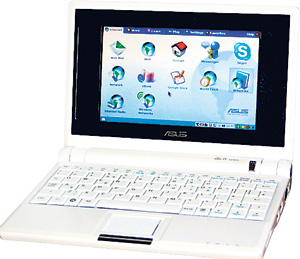 |
| The netbook trend began with ASUS and their ‘Eee PC.’ |
However, the user base for the netbook was with Microsoft. Windows XP made its appearance in netbooks in early 2008 which boosted netbook sales thirty times more than the previous year to roughly 11 million and is expected to grow to 35 million in 2009. The primary design for netbooks was for web browsing and e-mailing, which meant it relied heavily on the Internet. It possess a number of cool features, the main one being Wi-Fi access to the Internet. You’ll find standard features such as one or more USB ports and headphone and microphone outlets, as well as things such as a built in camera.
Some other features included are; 9 – 10 inch screen, battery power up to 4 hours and up to 180 GB of hard disk space.
The netbook trend began with ASUS and their ‘Eee PC’. Since then, other brands that have entered the market include Dell, Acer, HP, Intel, MSI, Toshiba, Sony and various others. Basically every computer manufacturer now has its own model of netbook on the market. Acer Aspire One netbooks and the Dell Inspiron Mini 9 are amongst the favourites.
The price of netbooks ranges from about $300 to $1000 depending on brand and netbook features.
The Sony VAIO netbook is $900, which I believe to be the prettiest netbook available today.
How to pick a netbook
Getting information on the different brands of netbooks is easy. The difficult part is, finding the right one that fits your purpose and makes the investment worthwhile. I’ll share with you the approach I took in purchasing my first netbook. The first decision point was the price. At a cost of only $299, this was an easy decision to take. It was affordable and looked really cool! Then comes the decision of picking the right brand and model.
This depended on the type of work I do, which is mostly writing documents, spreadsheets, emails and of course listening to music and watching movies. None of these tasks require a massive load of memory and processing power. But I did need lots of space to store my music collection and all the documents. Based on these facts I decided to go with a netbook that was affordable and primarily had a lot of hard disk space.
Students will find it very handy in the classroom for taking down notes and reading up on latest information on-line.
Toshiba Satellite Pro S300-11G review

With mobility the key selling point of 3G broadband, laptops featuring it are inevitably highly portable – and also highly expensive. The Toshiba Satellite Pro S300-11G breaks this tradition by being large and affordable.
The 15.4-inch screen is considerably bigger than many other ultraportables, but it features a lower resolution than the Lenovo ThinkPad X301 and Sony VAIO VGN-P11Z/R, so images aren't as sharp.
It's a bright panel, but colours lack depth and you'll have to turn the brightness settings down to get the best out of it. Unusually for a business machine, you'll find a glossy Super-TFT coating, increasing reflections when out and about.
Graphics are handled by an integrated Intel chip, offering similar multimedia performance to the other laptops. DVDs and video files play smoothly, and the S300 handles office tasks with aplomb, but don't expect to be able to play games.
Great usability
The keyboard on this laptop offers impressive usability, with all of the keys moving with a comfortable click. It's not the quietest of boards to type on, however, even if it is comfortable, and lacks the finesse of the Lenovo.
Considering the size of the chassis, the touchpad is cramped, and lags behind the usability offered by the Lenovo or the HP, failing to take advantage of the extra size.
As a corporate workhorse, this laptop makes no concessions to style, with a design that's business-like at best. One thing that can't be disputed is the strength this bulky design has to offer – the thick screen surround offers plenty of protection for the display and none of the plastics flex under pressure.
The thick hinges also hold the screen firmly in place when typing, and this is a machine that will easily withstand daily use.
Bulking out
It comes at a price, however, and the Toshiba is too bulky to carry comfortably on the daily commute. The thick chassis also means you will have to choose your laptop bag carefully, as you may struggle to fit it in smaller cases.
As with other 3G enabled machines, the SIM card is located under the battery, and this laptop isn't tied to a specific network carrier. Networking features are comprehensive, with 802.11n Wi-Fi and Gigabit Ethernet both in place.
The 250GB hard drive offers a generous amount of storage space, and four USB ports make it easy to connect all of your peripherals.
The sheer bulk of this laptop will be enough to put off some users, but for those who don't mind the heavier weight and larger dimensions, it's a well made machine that offers good value for money.
Toshiba's new laptops sharpen up Internet video
Toshiba is putting its quad-core SpursEngine chip to use in several new laptops to improve the quality of Internet video images.
The company's new Qosmio multimedia laptops, which will appear in Japan on Friday before becoming available worldwide, will use the graphics processing chip to clean up video from sites such as YouTube, the company said Tuesday.
The function will work when playing video fullscreen -- not when it's played in a window on a Web site -- and only when using Internet Explorer. Toshiba couldn't immediately explain why it won't work with other Web browsers.
The SpursEngine was developed by Toshiba and is based on the same architecture as the Cell Broadband Engine microprocessor that powers the PlayStation 3 console. While the Cell contains a Power PC core and eight "Synergistic Processing Elements" cores, the SpursEngine contains only four of the SPE cores.
The chip also contains a hardware encoder and decoder for MPEG2 and MPEG4 AVC/H.264 video and is designed to be used as a co-processor in a PC for handling of calculation-intensive work such a real-time high-definition graphics processing. In the new Qosmio machines it works alongside an Intel Core2 Duo processor.
A previous version of the Qosmio also included the SpursEngine chip but when cleaning up video it only worked with DVD playback and not Internet streaming.
The Qosmio is Toshiba's flagship laptop and the new models come with features and price tags to match that position.
The top-of-the-range G50 includes an 18.4-inch widescreen full high-def LCD screen, 2.66GHz Core2 Duo processor, a 640GB hard disk and dual digital TV tuners. It will go on sale from Friday in Japan and costs around ¥340,000 (US$3,420). Mid- and low-end Qosmio machines will also be offered for ¥260,000 and ¥210,000 respectively.
The computers will also go on sale outside Japan although international launch dates are yet to be fixed.
Toshiba Satellite A355-S6925 16-inch Budget Laptop PC
The Bottom Line
Apr 20 2009 - Toshiba's Satellite A355-S6925 offers a fair amount of performance and strong features for its $750 price tag. One the biggest advantages it has is the wide range of peripheral connectors on the laptop including eSATA and FireWire, but it also shows one of its flaws because it lacks an HDMI connector for use with newer digital displays. Still, those that can look past this and its slightly larger and heavier size can get a very well rounded budget laptop.Pros
- Faster Core 2 Duo Processor With 4GB of DDR2 Memory
- Larger Hard Drive
- Wide Range of Peripheral Connectors
Cons
- Slightly Larger and Heavier Due to 16-inch Screen
- Could Really Use HDMI Output
- Fair Amount of Trialware
Description
- Intel Core 2 Duo T6400 Dual Core Mobile Processor
- 4GB PC2-6400 DDR2 Memory
- 320GB 5400rpm SATA Hard Drive
- 8x DVD+/-RW Dual Layer Burner With Label Flash Support
- 16" WXGA (1366x768) Display With 1.3 Megapixel Webcam
- Intel GMA 4500MHD Integrated Graphics
- v.92 56Kbps Modem, Fast Ethernet, 802.11a/g/n Wireless
- Four USB 2.0, eSATA, FireWire, VGA, ExpressCard/54, 5-in-1 Card Reader
- 15.1" x 10.5" x 1.5" @ 6.5 lbs.
- Vista Home Premium 64-bit, Works, Ulead DVD, Norton 360
Guide Review - Toshiba Satellite A355-S6925 16-inch Budget Laptop PC
Apr 20 2009 - The Toshiba Satellite A355-S6925 offers a fair level of performance for a low cost laptop. Instead of use the Pentium Dual-Core processors like many others, they decided to use the Core 2 Duo T6400 with its larger cache to give it an edge in performance. They also included 4GB of the PC2-6400 DDR2 memory to provide this system with less chance of a slow down from the memory systems.
Storage is also very good for the Satellite A355-S6925. Rather than the more typical 250GB hard drive, Toshiba has elected to use the larger 320GB drive that allows the system to hold more programs and data. The dual layer DVD burner also has the ability to burn labels directly to Label Flash compatible media but this is more difficult to do as the media is not as common as the competing LightScribe format.
The 16-inch display is a tad larger than the more common 15.4 to 15.6-inch displays yet with the same 1366x768 resolution found in the 16:9 aspect ratio displays. This makes the screen a bit easier to read for those with lesser eyesight but it does increase the overall size and weight of the laptop. The integrated Intel GMA 4500MHD graphics also really prevent it from being used for 3D gaming.
Probably the best aspect of the Satellite A355-S6925 is the inclusion of peripheral connectors not typically found in budget laptops. This includes a FireWire port for using with digital camcorder or storage devices and eSATA for high performance external storage. The only downside is that Toshiba did not include an HDMI video output for use with newer digital monitors and HDTVs.
Overall, the Satellite A355-S6925 may be a bit on the expensive side of budget laptops, but it makes up for it with better performance and more overall features.
Monday, April 20, 2009
Dell adding Samsung's encrypted SSDs to its arsenal

Dell's been doing both solid state and encrypted drives for some time now, but only now is the company combining both efforts and preparing to offer encrypted SSDs in the coming months. The Samsung-manufactured drives will come in 64GB, 128GB, and 256GB options, and though the hardware encryption method isn't specified, we'd venture a guess it'll have something to do with Trusted Computer Group's 128-bit standards adopted by Sammy and virtually every other drive maker back in January. No word just yet on how much they'll cost, but if current prices are any indication, it won't come cheap.
Dell GX280 Special
DELL OptiPlex GX280 Desktop
SKU: Dell GX280 Special-28902-261520070-1
Price: $149.99
SKU: Dell GX280 Special-28902-261520070-1
Price:
$149.99 Dell's OptiPlex business desktops have always been about power and management features, and the new OptiPlex GX280 is not different. Housed in a space-saving small-desktop chassis that's easy to service, the GX280 utilizes the latest technology to run cool and quiet, and it offers better-than-average graphics for a corporate PC.
This fully refurbished computer has
P4-2.8GHz Processor
512MB Memory
40GB HDD
DVD Drive
Genuine Microsoft WinXP Professional
Recovery CD
1 Year Free Online MicroSoft Support
Dell Dimension C521 Desktop Computer
 Manufacturer: Dell
Configration: Athlon 64 X2 4000+ 2.00GHz/320GB/2GB
CN Number: CN0000002
Category: Computer System> Destop Computer
Dell Dimension C521 Desktop Computer Details
Dell Dimension C521 Desktop Computer. AMD Athlon™ 64 X2 Dual-Core 4000+. 2GB Dual Channel DDR2 SDRAM at 667MHz- 2DIMMs, 320GB Serial ATA Hard Drive (7200RPM) w/DataBurst Cache™. 19 inch E197FP Analog Flat Panel. NVIDIA GeForce 6150 LE Integrated Graphics GPU. 16x DVD+/-RW Drive. Integrated 7.1 Channel Audio. Integrated 10/100 Ethernet. 56K PCI Data Fax Modem. Dell USB Keyboard and Dell Optical USB Mouse
Subscribe to:
Posts (Atom)
