Now we will talk about Forex marketing. There is a business opportunity available that can cost very little to set up, and can be run by dedicating as little as one hour per day to it. This phenomenal business opportunity can earn you six figure annual profits, and your income will never be affected by a recession.
What is this incredible business opportunity? Well currency trading of course, and it can be done from the comfort of a computer (preferably a laptop) with an Internet connection. If a home based business is what you're looking for, trading the Forex market in my opinion, is the best business model to pursue.
While the ideal amount of money to start trading currency with is $2,000.00, one can start with a mere $200.00 and have the ability to leverage their trading at a rate of 100 to 1, making it possible to trade $20,000.00 worth of currency. After you've completed your first trade, simply take your profit earned off of your $200.00 investment, and put in another trade by reinvesting the full amount (principle+profit). This process can be repeated over an over again in order to build capital, until you reach a level of capital investment that you are comfortable with. You can then simply withdraw your profits and continue to reinvest your principle.
Among the many advantages that this business provides, it is truly protected from recession simply because of the fact that as one currency rises, another currency falls. Likewise as one currency falls, another one rises. Trading the Forex market can be done from virtually anywhere in the world where an Internet connection is available. Just pick up your laptop and go! You have no boss to answer to and you have the ability to take vacations whenever you please. The potential gains that can be made through Forex trading are absolutely outstanding. This is a business that truly has the ability to put you in complete control of your financial destiny.
One of the first questions that many aspiring traders have about this business is "how easy is it to learn"? Well the best way to answer that is by giving an example. About 24 years ago, in 1983, long before the Internet as we know it first came about, a trader by the name of Richard Dennis took it upon himself to teach a fine group of every day people like you and me, how to trade. These men and women had never traded the financial markets and he was able to have them completely taught in a mere 14 days. Two weeks! Of course it would take practice before they were trading the markets successfully in a consistent manner, but they had all the basic knowledge that they needed in order to do so. This group of traders went on to earn a collective 100,000,000 dollars! Some of them eventually became some of the most famous traders in all of history!
The fact of the matter is that trading currency, or really any financial instrument, can be learned by absolutely anyone of average intelligence who is willing to put in the time and effort. Is every aspiring trader going to eventually make millions? I would venture to say probably not, simply because it is likely that not everyone will take the steps necessary to reach such a lofty goal. However if one does take the necessary steps, I see no reason why they cannot achieve millionaire status. It is simply a process and consistency is the key, especially in the Forex market where the effort required to achieve great rewards, is really very minimal in comparison to some of the other markets.
More specifically, the real key to success in the business of trading currency is working with leverage. For example, leveraging your money with a deposit of $500.00, gives you that ability to trade with $50,000.00. This degree of leverage greatly magnifies both your gains and your losses. Your degree of success will be determined by how well you learn to effectively deal with leverage, and this is definitely a market where practice makes perfect!
Generally speaking, the best way to trade the Forex market is by following chart patterns that repeat themselves, using these patterns as your guide. The engine that drives the activity on these charts are trends in the world economy, which in turn affects or more specifically actually is, the currency market.
Thursday, April 30, 2009

Forex Business Plan
Today we will talk about Forex Busines Plan. Whether you are planning to start a brand-new business, expand an existing company, or get financing for a business venture, you will need to write a business plan. A business plan not only lends your business a sense of credibility, but also helps you to cover all your bases, increasing your chances of success.
Although writing a business plan can be a lengthy, intimidating project, it is not necessarily difficult. Here is an overview of how to write a successful business plan.
What to Include in Your Business Plan
Your business plan needs to demonstrate that you have thoroughly considered all aspects of running your business. To that end, the standard business plan has nine major sections, covering everything from your business’s mission statement to a detailed financial analysis.
Executive Summary
The first – and most important – section of your business plan is the executive summary. This section is so important that it should literally be the first thing the reader sees – even before the table of contents! However, it should also be written last, as you’ll have a better understanding of the overall message of your business plan after you’ve researched and written the other sections.
One of the most important parts of the executive summary is the mission statement. The mission statement is only three or four sentences long, but it should pack the most punch out of everything else in your business plan: Those four sentences are responsible for not only defining your business, but also capturing the interest of your reader.
The rest of your executive summary should fill in the important details that the mission statement glosses over. For instance, your executive summary should include a short history of the business, including founder profiles and start date; a current snapshot, listing locations, numbers of employees, and products or services offered; and a summary of future plans and goals.
This section is a candidate for a bulleted format, which allows you to list main points in a manner that is easy to scan. Avoid using too much detail – remember, this section is a summary. A page or two is usually sufficient for an executive summary.
Market Analysis
The next section of your business plan focuses on market analysis. In order to show that your business has a reasonable chance for success, you will need to thoroughly research the industry and the market you intend to sell to. No bank or investor is going to back a doomed venture, so this section is sure to fall under especially close scrutiny if you are looking for financing.
Your market analysis should describe your industry, including the size, growth rate, and trends that could affect the industry. This section should also describe your target market – that is, the type or group of customers that your company intends to serve. The description of your target market should include detail such as:
• Distinguishing characteristics
• The needs your company or product line will meet
• What media and/or marketing methods you’ll use to reach them
• What percentage of your target market you expect to be able to wrest away from your competitors
In addition, your market analysis should include the results of any market tests you have done, and an analysis of the strengths and weaknesses of your competitors.
Company Description
After your market analysis, your business plan will need to include a description of your company. This section should describe:
• The nature of your business
• The needs of the market
• How your business will meet these needs
• Your target market, including specific individuals and/or organizations
• The factors that set you apart from your competition and make you likely to succeed
Although some of these things overlap with the previous section, they are still necessary parts of your company description. Each section of your business plan should have the ability to stand on its own if need be. In other words, the company description should thoroughly describe your company, even if certain aspects are covered in other sections.
Organization and Management
Once you have described the nature and purpose of your company, you will need to explain your staff setup. This section should include:
• The division of labor – how company processes are divided among the staff
• The management hierarchy
• Profiles of the company’s owner(s), management personnel, and the Board of Directors
• Employee incentives, such as salary, benefits packages, and bonuses
This goal of this section is to demonstrate not only good organization within the company, but also the ability to create loyalty in your employees. Long-term employees minimize human resource costs and increase a business’s chances for success, so banks and investors will want to see that you have an effective system in place for maintaining your staff.
Marketing and Sales Management
The purpose of the marketing and sales section of your business plan is to outline your strategies for marketing your products or services. This section also plans for company growth by describing how the growth could take place.
The section should describe your company’s:
• Marketing methods
• Distributions methods
• Type of sales force
• Sales activities
• Growth strategies
Product or Services
Following the marketing section of your business plan, you will need a section focusing on the product or services your business offers. This is more than a simple description of your product or services, though. You will also need to include:
• The specific benefits your product or service offers customers
• The specific needs of the market, and how your product will meet them
• The advantages your product has over your competitors
• Any copyright, trade secret, or patent information pertaining to your product
• Where any new products or services are in the research and development process
• Current industry research that you could use in the development of products and services
Funding Request
Only once you have described your business from head to toe are you ready to detail your funding needs. This section should include everything a bank or investor needs in order to understand what type of funding you want:
• How much money you need now
• How much money you think you will need over the next five years
• How the money you borrow will be used
• How long you will need funding
• What type of funding you want (i.e. loans, investors, etc.)
• Any other terms you want the funding arrangement to include
Financials
The financials section in your business plan supports your request for outside funding. This section provides an analysis of your company’s prospective financial success. The section also details your company’s financial track record for the past three to five years, unless you are seeking financing for a startup business.
The financials section should include:
• Company income statements for prior years
• Balance sheets for prior years
• Cash flow statements for prior years
• Forecasted company income statements
• Forecasted balance sheets
• Forecasted cash flow statements
• Projections for the next five years – every month or quarter for the first year, with longer intervals for the remaining years
• Collateral you can use to secure a loan
The financials section is a great place to include visuals such as graphs, particularly if you predict a positive trend in your projected financials. A graph allows the reader to quickly take in this information, and may do a better job of encouraging a bank or investor to finance your business. However, be sure that the amount of financing you are requesting is in keeping with your projected financials – no matter how impressive your projections are, if you are asking for more money than is warranted, no bank or investor will give it to you.
Appendices
The appendix is the final section in your business plan. Essentially, this is where you put all of the information that doesn’t fit in the other eight sections, but that someone – particularly a bank or investor – might need to see.
For instance, the market analysis section of your business plan may list the results of market studies you have done as part of your market research. Rather than listing the details of the studies in that section, where they will appear cumbersome and detract from the flow of your business plan, you can provide this information in an appendix.
Other information that should be relegated to an appendix includes:
• Credit histories for both you and your business
• Letters of reference
• References that have bearing on your company and your product or service, such as magazines or books on the topic
• Company licenses and patents
• Copies of contracts, leases, and other legal documents
• Resumes of your top managers
• Names of business consultants, such as your accountant and attorney
Writing a Successful Business Plan
Despite the quantity of information contained in your business plan, it should be laid out in a format that is easy to read. Just like with any piece of business writing, it is important to craft your business plan with your intended audience in mind – and the bankers, investors, and other busy professionals who will read your business plan almost certainly won’t have time to read a tedious document with long-winded paragraphs and large blocks of text.
Business plans for startup companies and company expansions are typically between twenty to forty pages long, but formatting actually accounts for a lot of this length. A strong business plan uses bullet points throughout to break up long sections and highlight its main points. Visuals such as tables and charts are also used to quickly relay specific information, such as trends in sales and other financial information. These techniques ensure that the reader can skim the business plan quickly and efficiently.
Think of your audience as only having fifteen minutes to spend on each business plan that comes across their desks. In that fifteen minutes, you not only have to relay your most important points, but also convince the reader that your business venture merits a financial investment. Your best bet is a well-researched business plan, with an organized, easy-to-read format and clear, confident prose.
Wednesday, April 22, 2009
Sony Vaio FZ 21S

SPECIFICATIONS:
2.2GHz Intel Core 2 Duo T7500
3GB 667MHz DDR2 RAM
200GB Fujitsu MHY2200BH hard disk
Sony NEC Optiarc Blu-ray ROM/DVD writer
Nvidia GeForce 8600M GS graphics (256 MB dedicated)
15.4in 1,280 x 800 TFT
S-Video, HDMI outputs
3 x USB
Mini-FireWire
SD/Memory Stick card reader
ExpressCard34
SigmaTel High Definition Audio
Bluetooth
802.11abg + draft-n WLAN
10/100 ethernet
1.3mp webcam
Windows Vista Home Premium
1yr C&R warranty
355 x 246 x 31mm (WDH)
2.8kg
The Sony Vaio VGN-FS195XP
he Sony Vaio VGN-FS195XP is a real head turner, combining the widescreen, performance and good looks of Sony's top of the range A Series, with the low cost and compact size of Sony's entry level laptop K Series. You knowwhat they say about a family's middle child. They're usually themost practical and reliable of the bunch, offering the bestqualities of their older and younger siblings in one package.Such is the case with the new Sony VAIOVGN-FS195XP. It inherited the exceptional screen size andperformance of Sony's top-end A Series with the low cost andcompact size of the manufacturer's starter-notebook K Series.
Take the FS195XP's good looks. This Vaio'swidescreen spans 15.4 inches and features Sony's X-blacktechnology. Two lamps light up the screen instead of one. Theyprovide greater control over contrast and brightness. So thescreen produces less glare in bright settings in an office oroutdoors, for instance, but can easily compensate with stunningclarity when needed, such as in meetings or on a dark plane.
To make it easier to lug the widescreen onto said plane, Sonyfit this Vaio into a chassis that's only 1.54 inches (39 mm)thick and 6.4 pounds (2.9 kg).
Just because it's lithe does not mean Sony forgotsomething on the inside. They stacked the VGN-FS195XP with anIntel Pentium M740 that boasts a 1.73GHz speed. Combined with a512MB DDR SDRAM and 100GB hard drive, the package was timed at azippy score of 221 when tested on the MobileMark 2002.
For wireless features, the VAIO offers a middle-of-the-road 10/100 Ethernetconnection and soon-to-be-outdated Intel PRO/wireless 2200BGadapter. Let it be known, however, that Sony promises that theVGN-FS195XP will be Sonoma compliant at sale time.
When it comes to multimedia performance, this Sony is abit of a flip-flopper. Its High-Definition Support blesses thenotebook with the power to edit 3-D footage from a high-defcamcorder. But the laptop's GPU is the basic-level NVidia GeForce Go 6200. Although this GPU can support DirectX9 extensions, don't expect it to handle your wildest gamingdesires.
Take the FS195XP's good looks. This Vaio'swidescreen spans 15.4 inches and features Sony's X-blacktechnology. Two lamps light up the screen instead of one. Theyprovide greater control over contrast and brightness. So thescreen produces less glare in bright settings in an office oroutdoors, for instance, but can easily compensate with stunningclarity when needed, such as in meetings or on a dark plane.
To make it easier to lug the widescreen onto said plane, Sonyfit this Vaio into a chassis that's only 1.54 inches (39 mm)thick and 6.4 pounds (2.9 kg).
Just because it's lithe does not mean Sony forgotsomething on the inside. They stacked the VGN-FS195XP with anIntel Pentium M740 that boasts a 1.73GHz speed. Combined with a512MB DDR SDRAM and 100GB hard drive, the package was timed at azippy score of 221 when tested on the MobileMark 2002.
For wireless features, the VAIO offers a middle-of-the-road 10/100 Ethernetconnection and soon-to-be-outdated Intel PRO/wireless 2200BGadapter. Let it be known, however, that Sony promises that theVGN-FS195XP will be Sonoma compliant at sale time.
When it comes to multimedia performance, this Sony is abit of a flip-flopper. Its High-Definition Support blesses thenotebook with the power to edit 3-D footage from a high-defcamcorder. But the laptop's GPU is the basic-level NVidia GeForce Go 6200. Although this GPU can support DirectX9 extensions, don't expect it to handle your wildest gamingdesires.
IBM ThinkPad R60 9457

The ThinkPad R60 has everything you have come to expect from a ThinkPad packed into a sturdy, lightweight container. So you can log on and do business just about anywhere. The ThinkPad R60 can handle the rigors of use in the office and on the road. Powered by an Intel Celeron M 420 1.6 GHz processor and 512 MB of RAM, it speeds you through all demanding projects. Features a magnesium alloy roll cage and shock mounted hard drives to help reduce some system failures and help increase durability. Add high speed processors, an advanced graphics solution and 14.1" screen, and you get a notebook fully equipped to grow your business, not your overhead.
IBM ThinkPad T42 14-inch Laptop with Docking Station (Refurb)
 Product Description:
BM ThinkPad T42 14-inch Laptop with Docking Station (Refurb)
- Take your work anywhere with this IBM laptop computer
- Computer boasts a 14-inch XGA display and a 1.7 GHz Pentium M processor
- Notebook computer features a 40GB hard drive
- Operating system: Windows XP Pro
- System memory: 512MB
- Optical drive: DVD/CD-RW combo
- Graphics: ATI Radeon 7500
- Network: 802.11b wireless, 10/100
- Modem: 56K
- Expansion slots: one Type III PC Card slot
- External ports: two USB 2.0, one parallel, one S-Video, one VGA, one microphone/audio-in, one headphone/speaker/audio-out
- Battery: 6-cell battery
- Computer measures 1.8 inches high x 12.3 inches wide x 10 inches long
- Docking system included
Mini Laptop
Tech Talk with Deveka
I recently purchased a new laptop that weighs less than 1 kilogram, which makes it lighter than a telephone directory. This is a new class of laptops known as netbook that emerged back in 2007, but took real momentum only in 2008. The reason for this was that the initial netbooks came with Linux pre-installed, and the Linux user base was smaller than that of Windows. One of the reasons why vendors chose an open source operating system was because it was easy for them to create a simplified user than to get Microsoft to do a smaller version of Windows. This is a fine example of how open source software can play a leading role in developing cutting edge technology and get into the market ahead of others.
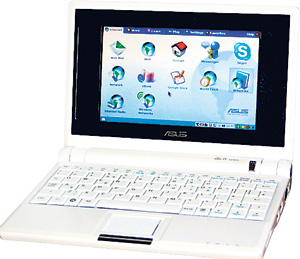 |
| The netbook trend began with ASUS and their ‘Eee PC.’ |
However, the user base for the netbook was with Microsoft. Windows XP made its appearance in netbooks in early 2008 which boosted netbook sales thirty times more than the previous year to roughly 11 million and is expected to grow to 35 million in 2009. The primary design for netbooks was for web browsing and e-mailing, which meant it relied heavily on the Internet. It possess a number of cool features, the main one being Wi-Fi access to the Internet. You’ll find standard features such as one or more USB ports and headphone and microphone outlets, as well as things such as a built in camera.
Some other features included are; 9 – 10 inch screen, battery power up to 4 hours and up to 180 GB of hard disk space.
The netbook trend began with ASUS and their ‘Eee PC’. Since then, other brands that have entered the market include Dell, Acer, HP, Intel, MSI, Toshiba, Sony and various others. Basically every computer manufacturer now has its own model of netbook on the market. Acer Aspire One netbooks and the Dell Inspiron Mini 9 are amongst the favourites.
The price of netbooks ranges from about $300 to $1000 depending on brand and netbook features.
The Sony VAIO netbook is $900, which I believe to be the prettiest netbook available today.
How to pick a netbook
Getting information on the different brands of netbooks is easy. The difficult part is, finding the right one that fits your purpose and makes the investment worthwhile. I’ll share with you the approach I took in purchasing my first netbook. The first decision point was the price. At a cost of only $299, this was an easy decision to take. It was affordable and looked really cool! Then comes the decision of picking the right brand and model.
This depended on the type of work I do, which is mostly writing documents, spreadsheets, emails and of course listening to music and watching movies. None of these tasks require a massive load of memory and processing power. But I did need lots of space to store my music collection and all the documents. Based on these facts I decided to go with a netbook that was affordable and primarily had a lot of hard disk space.
Students will find it very handy in the classroom for taking down notes and reading up on latest information on-line.
Toshiba Satellite Pro S300-11G review

With mobility the key selling point of 3G broadband, laptops featuring it are inevitably highly portable – and also highly expensive. The Toshiba Satellite Pro S300-11G breaks this tradition by being large and affordable.
The 15.4-inch screen is considerably bigger than many other ultraportables, but it features a lower resolution than the Lenovo ThinkPad X301 and Sony VAIO VGN-P11Z/R, so images aren't as sharp.
It's a bright panel, but colours lack depth and you'll have to turn the brightness settings down to get the best out of it. Unusually for a business machine, you'll find a glossy Super-TFT coating, increasing reflections when out and about.
Graphics are handled by an integrated Intel chip, offering similar multimedia performance to the other laptops. DVDs and video files play smoothly, and the S300 handles office tasks with aplomb, but don't expect to be able to play games.
Great usability
The keyboard on this laptop offers impressive usability, with all of the keys moving with a comfortable click. It's not the quietest of boards to type on, however, even if it is comfortable, and lacks the finesse of the Lenovo.
Considering the size of the chassis, the touchpad is cramped, and lags behind the usability offered by the Lenovo or the HP, failing to take advantage of the extra size.
As a corporate workhorse, this laptop makes no concessions to style, with a design that's business-like at best. One thing that can't be disputed is the strength this bulky design has to offer – the thick screen surround offers plenty of protection for the display and none of the plastics flex under pressure.
The thick hinges also hold the screen firmly in place when typing, and this is a machine that will easily withstand daily use.
Bulking out
It comes at a price, however, and the Toshiba is too bulky to carry comfortably on the daily commute. The thick chassis also means you will have to choose your laptop bag carefully, as you may struggle to fit it in smaller cases.
As with other 3G enabled machines, the SIM card is located under the battery, and this laptop isn't tied to a specific network carrier. Networking features are comprehensive, with 802.11n Wi-Fi and Gigabit Ethernet both in place.
The 250GB hard drive offers a generous amount of storage space, and four USB ports make it easy to connect all of your peripherals.
The sheer bulk of this laptop will be enough to put off some users, but for those who don't mind the heavier weight and larger dimensions, it's a well made machine that offers good value for money.
Toshiba's new laptops sharpen up Internet video
Toshiba is putting its quad-core SpursEngine chip to use in several new laptops to improve the quality of Internet video images.
The company's new Qosmio multimedia laptops, which will appear in Japan on Friday before becoming available worldwide, will use the graphics processing chip to clean up video from sites such as YouTube, the company said Tuesday.
The function will work when playing video fullscreen -- not when it's played in a window on a Web site -- and only when using Internet Explorer. Toshiba couldn't immediately explain why it won't work with other Web browsers.
The SpursEngine was developed by Toshiba and is based on the same architecture as the Cell Broadband Engine microprocessor that powers the PlayStation 3 console. While the Cell contains a Power PC core and eight "Synergistic Processing Elements" cores, the SpursEngine contains only four of the SPE cores.
The chip also contains a hardware encoder and decoder for MPEG2 and MPEG4 AVC/H.264 video and is designed to be used as a co-processor in a PC for handling of calculation-intensive work such a real-time high-definition graphics processing. In the new Qosmio machines it works alongside an Intel Core2 Duo processor.
A previous version of the Qosmio also included the SpursEngine chip but when cleaning up video it only worked with DVD playback and not Internet streaming.
The Qosmio is Toshiba's flagship laptop and the new models come with features and price tags to match that position.
The top-of-the-range G50 includes an 18.4-inch widescreen full high-def LCD screen, 2.66GHz Core2 Duo processor, a 640GB hard disk and dual digital TV tuners. It will go on sale from Friday in Japan and costs around ¥340,000 (US$3,420). Mid- and low-end Qosmio machines will also be offered for ¥260,000 and ¥210,000 respectively.
The computers will also go on sale outside Japan although international launch dates are yet to be fixed.
Toshiba Satellite A355-S6925 16-inch Budget Laptop PC
The Bottom Line
Apr 20 2009 - Toshiba's Satellite A355-S6925 offers a fair amount of performance and strong features for its $750 price tag. One the biggest advantages it has is the wide range of peripheral connectors on the laptop including eSATA and FireWire, but it also shows one of its flaws because it lacks an HDMI connector for use with newer digital displays. Still, those that can look past this and its slightly larger and heavier size can get a very well rounded budget laptop.Pros
- Faster Core 2 Duo Processor With 4GB of DDR2 Memory
- Larger Hard Drive
- Wide Range of Peripheral Connectors
Cons
- Slightly Larger and Heavier Due to 16-inch Screen
- Could Really Use HDMI Output
- Fair Amount of Trialware
Description
- Intel Core 2 Duo T6400 Dual Core Mobile Processor
- 4GB PC2-6400 DDR2 Memory
- 320GB 5400rpm SATA Hard Drive
- 8x DVD+/-RW Dual Layer Burner With Label Flash Support
- 16" WXGA (1366x768) Display With 1.3 Megapixel Webcam
- Intel GMA 4500MHD Integrated Graphics
- v.92 56Kbps Modem, Fast Ethernet, 802.11a/g/n Wireless
- Four USB 2.0, eSATA, FireWire, VGA, ExpressCard/54, 5-in-1 Card Reader
- 15.1" x 10.5" x 1.5" @ 6.5 lbs.
- Vista Home Premium 64-bit, Works, Ulead DVD, Norton 360
Guide Review - Toshiba Satellite A355-S6925 16-inch Budget Laptop PC
Apr 20 2009 - The Toshiba Satellite A355-S6925 offers a fair level of performance for a low cost laptop. Instead of use the Pentium Dual-Core processors like many others, they decided to use the Core 2 Duo T6400 with its larger cache to give it an edge in performance. They also included 4GB of the PC2-6400 DDR2 memory to provide this system with less chance of a slow down from the memory systems.
Storage is also very good for the Satellite A355-S6925. Rather than the more typical 250GB hard drive, Toshiba has elected to use the larger 320GB drive that allows the system to hold more programs and data. The dual layer DVD burner also has the ability to burn labels directly to Label Flash compatible media but this is more difficult to do as the media is not as common as the competing LightScribe format.
The 16-inch display is a tad larger than the more common 15.4 to 15.6-inch displays yet with the same 1366x768 resolution found in the 16:9 aspect ratio displays. This makes the screen a bit easier to read for those with lesser eyesight but it does increase the overall size and weight of the laptop. The integrated Intel GMA 4500MHD graphics also really prevent it from being used for 3D gaming.
Probably the best aspect of the Satellite A355-S6925 is the inclusion of peripheral connectors not typically found in budget laptops. This includes a FireWire port for using with digital camcorder or storage devices and eSATA for high performance external storage. The only downside is that Toshiba did not include an HDMI video output for use with newer digital monitors and HDTVs.
Overall, the Satellite A355-S6925 may be a bit on the expensive side of budget laptops, but it makes up for it with better performance and more overall features.
Monday, April 20, 2009
Dell adding Samsung's encrypted SSDs to its arsenal

Dell's been doing both solid state and encrypted drives for some time now, but only now is the company combining both efforts and preparing to offer encrypted SSDs in the coming months. The Samsung-manufactured drives will come in 64GB, 128GB, and 256GB options, and though the hardware encryption method isn't specified, we'd venture a guess it'll have something to do with Trusted Computer Group's 128-bit standards adopted by Sammy and virtually every other drive maker back in January. No word just yet on how much they'll cost, but if current prices are any indication, it won't come cheap.
Dell GX280 Special
DELL OptiPlex GX280 Desktop
SKU: Dell GX280 Special-28902-261520070-1
Price: $149.99
SKU: Dell GX280 Special-28902-261520070-1
Price:
$149.99 Dell's OptiPlex business desktops have always been about power and management features, and the new OptiPlex GX280 is not different. Housed in a space-saving small-desktop chassis that's easy to service, the GX280 utilizes the latest technology to run cool and quiet, and it offers better-than-average graphics for a corporate PC.
This fully refurbished computer has
P4-2.8GHz Processor
512MB Memory
40GB HDD
DVD Drive
Genuine Microsoft WinXP Professional
Recovery CD
1 Year Free Online MicroSoft Support
Dell Dimension C521 Desktop Computer
 Manufacturer: Dell
Configration: Athlon 64 X2 4000+ 2.00GHz/320GB/2GB
CN Number: CN0000002
Category: Computer System> Destop Computer
Dell Dimension C521 Desktop Computer Details
Dell Dimension C521 Desktop Computer. AMD Athlon™ 64 X2 Dual-Core 4000+. 2GB Dual Channel DDR2 SDRAM at 667MHz- 2DIMMs, 320GB Serial ATA Hard Drive (7200RPM) w/DataBurst Cache™. 19 inch E197FP Analog Flat Panel. NVIDIA GeForce 6150 LE Integrated Graphics GPU. 16x DVD+/-RW Drive. Integrated 7.1 Channel Audio. Integrated 10/100 Ethernet. 56K PCI Data Fax Modem. Dell USB Keyboard and Dell Optical USB MouseSaturday, March 28, 2009
US CurrenCy

Why were certain individuals chosen to be pictured on our paper currency?
What portraits are found on United States paper currency that is in circulation today? Whose portraits were included on currency notes that are no longer produced?
What is the significance of the symbols on the back of the one-dollar bill? I'm particularly interested in the eye and the pyramid.
What is the significance of the series date on our currency? Doesn't the date change each year as it does with coins?
What States are shown on the back of the five-dollar bill?
Why are the designs on our paper money being changed?
Question Why were certain individuals chosen to be pictured on our paper currency?
Answer As with our nation's coinage, the Secretary of the Treasury usually selects the designs shown on United States currency. Unless specified by an Act of Congress, the Secretary generally has the final approval. This is done with the advice of Bureau of Engraving and Printing (BEP) officials. In addition, the Commission on Fine Arts reviews all of the designs.
The law prohibits portraits of living persons from appearing on Government Securities. Therefore, the portraits on our currency notes are of deceased persons whose places in history the American people know well.
The basic face and back designs of all denominations of our paper currency in circulation today were selected in 1928, although they were modified to improve security against counterfeiting starting in 1996. A committee appointed to study such matters made those choices. The only exception is the reverse design of the one-dollar bill. Unfortunately, however, our records do not suggest why certain Presidents and statesmen were chosen for specific denominations.
^ TOP
Question What portraits are found on United States paper currency that is in circulation today? Whose portraits were included on currency notes that are no longer produced?
Answer United States currency notes now in production bear the following portraits: George Washington on the $1 bill, Thomas Jefferson on the $2 bill, Abraham Lincoln on the $5 bill, Alexander Hamilton on the $10 bill, Andrew Jackson on the $20 bill, Ulysses S. Grant on the $50 bill, and Benjamin Franklin on the $100 bill.
There are also several denominations of currency notes that are no longer produced. These include the $500 bill with the portrait of William McKinley, the $1,000 bill with a portrait of Grover Cleveland, the $5,000 bill with a portrait of James Madison, the $10,000 bill with a portrait of Salmon P. Chase, and the $100,000 currency note bearing a portrait of Woodrow Wilson.
^ TOP
Question What is the significance of the symbols on the back of the one-dollar bill? I'm particularly interested in the eye and the pyramid.
Answer The eye and the pyramid shown on the reverse side of the one-dollar bill are in the Great Seal of the United States. The Great Seal was first used on the reverse of the one-dollar Federal Reserve note in 1935. The Department of State is the official keeper of the Seal. They believe that the most accurate explanation of a pyramid on the Great Seal is that it symbolizes strength and durability. The unfinished pyramid means that the United States will always grow, improve and build. In addition, the "All-Seeing Eye" located above the pyramid suggests the importance of divine guidance in favor of the American cause. The inscription ANNUIT COEPTIS translates as "He (God) has favored our undertakings," and refers to the many instances of Divine Providence during our Government's formation. In addition, the inscription NOVUS ORDO SECLORUM translates as "A new order of the ages," and signifies a new American era.
^ TOP
Question What is the significance of the series date on our currency? Doesn't the date change each year as it does with coins?
AnswerA new series will result from a change in the Secretary of the Treasury, the Treasurer of the United States, and/or a change to the note's appearance such as a new currency design. After the Secretary of the Treasury changes, a new series year is adopted. When the Treasurer of the United States changes, a suffix letter is added to the series year (e.g. 1999A). Additional changes of the Treasurer, whereby the Secretary of the Treasury remains the same results in subsequent letter changes to the current series year (e.g. 1999B, 1999C, etc.). On newly designed notes, the series year may appear on the right or the left of the note’s face side. The year in which the currency is actually printed is not indicated on the note. Beginning with Series 1996 Federal Reserve notes, there are two prefix letters to the serial number. The first prefix letter indicates the series year. The second prefix letter indicates the issuing Reserve Bank. .
^ TOP
Question What States are shown on the back of the five-dollar bill?
Answer The vignette on the reverse of the five-dollar bill depicts the Lincoln Memorial. You may be aware that, engraved on that Memorial are the names of the 48 states in 1922, which was the year the Memorial was dedicated. There are engravings of 26 State names on front of the building, which appears on the note vignette. As a result, only 26 of the States appear on the note.
The upper frieze of the Memorial bears the States of Arkansas, Michigan, Florida, Texas, Iowa, Wisconsin, California, Minnesota, Oregon, Kansas, West Virginia, Nevada, Nebraska, Colorado, and North Dakota. The lower Frieze lists the States of Delaware, Pennsylvania, New Jersey, Georgia, Connecticut, Massachusetts, Maryland, Virginia, and New York. In addition, the engravings show the abbreviated names "Hampshire" (for New Hampshire) and "Carolina" (for South Carolina). We have no information why the prefixes for these states were not used.
^ TOP
Question Why are the designs on our paper money being changed?
AnswerTo protect your hard-earned money, the U.S. government expects to redesign its currency every seven to 10 years. Counterfeiting of U.S. currency has been kept at low levels through a combination of improvements in security features, aggressive law enforcement and education efforts to inform the public about how to check their currency.
The United States government continues issuing currency with enhanced designs and security features. A new $10 note was issued on March 2, 2006. This redesigned currency is safer, smarter and more secure:
Safer because it is harder to fake and easier to check; Smarter to stay ahead of tech-savvy counterfeiters; and, More Secure to protect the integrity of U.S. currency.
The most noticeable difference in the new designs is the introduction of subtle background colors, which makes it more burdensome for potential counterfeiters because it adds complexity to the note. The addition of color also makes it easier to distinguish between denominations because different background colors are used for each denomination.
Despite the addition of color, the redesigned notes preserve the distinct size, look and feel of traditional American currency – the world’s most familiar and circulated currency.
The Department of the Treasury has historically continued to honor previous designs of our currency. Furthermore, the Department has never recalled currency when introducing a new design. There are billions of dollars in U.S. currency circulating worldwide. Any new design, when issued, would enter circulation in a deliberate and organized way, avoiding any recall or exchange. This will ensure the continued confidence of people in the value of the U.S. currency they now possess.
Tuesday, March 24, 2009
Forex Real World
Understanding The FX Market
The enigma that’s the foreign exchange marketplace is also renowned as FX or it’s also seen to be referred to as the forex. All of these stand for the identical thing, which is dealing within many business enterprises, companies, banking concerns and authorities that are situated in assorted countries The rapid paced financial marketplace is ever-changing leaving required transactions to be completed by banks and brokers.
There are a variety of investment options you can make such as real estate, stocks, bonds, mutual funds etc… but there is only one option that has over US $2 trillion traded everyday and that is the foreign exchange market. Not long ago it was only institutions or very wealthy people that had connections with brokers, banks, and financial institutions that could trade in the forex market.
If your idea of painful foreign exchange trading, or Forex, includes mastering international rules and regulations and an ever-changing need for technological savvy then your prayers have been answered.
Many myths are going all around the internet about what exactly the forex market and managed forex accounts are really all about. The foreign exchange market is simply a place to buy and sell on currency with another. This is used by companies and people for purposes of travel, hedging or profit.
The popularity and interest in forex trading has resulted in a number of automated systems to be developed. This has resulted in a market expansion where banks and other large financial institutions are not the only players. When you trade the currency of one country for another currency, this is the place where it happens. What makes this one of the largest financial markets of the world?
Contrary to stock trading, as the global Forex market trades in every currency there is never a threat of insider trading. What separates a successful Forex trader and a consistent Forex loser is the level of their Forex trading education and the fundamentals that they follow in their individual Forex currency trading system.
The enigma that’s the foreign exchange marketplace is also renowned as FX or it’s also seen to be referred to as the forex. All of these stand for the identical thing, which is dealing within many business enterprises, companies, banking concerns and authorities that are situated in assorted countries The rapid paced financial marketplace is ever-changing leaving required transactions to be completed by banks and brokers.
There are a variety of investment options you can make such as real estate, stocks, bonds, mutual funds etc… but there is only one option that has over US $2 trillion traded everyday and that is the foreign exchange market. Not long ago it was only institutions or very wealthy people that had connections with brokers, banks, and financial institutions that could trade in the forex market.
If your idea of painful foreign exchange trading, or Forex, includes mastering international rules and regulations and an ever-changing need for technological savvy then your prayers have been answered.
Many myths are going all around the internet about what exactly the forex market and managed forex accounts are really all about. The foreign exchange market is simply a place to buy and sell on currency with another. This is used by companies and people for purposes of travel, hedging or profit.
The popularity and interest in forex trading has resulted in a number of automated systems to be developed. This has resulted in a market expansion where banks and other large financial institutions are not the only players. When you trade the currency of one country for another currency, this is the place where it happens. What makes this one of the largest financial markets of the world?
Contrary to stock trading, as the global Forex market trades in every currency there is never a threat of insider trading. What separates a successful Forex trader and a consistent Forex loser is the level of their Forex trading education and the fundamentals that they follow in their individual Forex currency trading system.
Friday, February 27, 2009
M B A STUDENT LAPTOP

MBA Laptop Features
This is where we match MBA laptop features with your laptop usage. This is often the harded part when it comes to purchasing. Because this laptop will be used for your MBA program, our job is a bit easier. Here is a list of the most important features to consider.
* Processor (CPU) - this is the brain of the computer, so get the best. I prefer offerings from Intel. Avoid value-line models like the Celeron processor. Look at the latest specs in GHz and see what you can afford.
* Memory (RAM) - this is the short-term storage used while the laptop is on. It affects how much you can do at one time (multi-tasking). The more the better - side on having too much. I would start at 1 GB and go from there.
* Hard Drive - there are a few things to consider on the hard drive. The obvious one is space. These days, you will not get anything less than 80 GB and that should be sufficient. The other consideration is the speed of the hard drive in RPMs. The higher the better.
The CPU, RAM, and Hard Drive will have a bigger effect on performance and reliability than any of the other MBA laptop features!
* Screen size - This is more of a personal preference. You can get a really small screen (less than 14 inches) that allows for more portability. On the other side of the coin, you may want a large, wide-screen laptop for easier viewing.
* Networking - You will want both a wireless card supporting the latest wireless frequencies as well as a Ethernet LAN jack. You will run into both kinds of networks.
* Ports and Drives - Make sure you have ports for a printer, keyboard, mouse, monitor, etc. Plenty of USB ports is nice. Also make sure you have an adequate CD or DVD drive. Get one that is writable so you can periodically make backups of your files.
* Operating System - The operating system (OS) is required to run the laptop and will come pre-installed. Most people choose the latest flavor of Windows. Some people opt for Apple laptops too. Apple has its own Mac OS X operating system.
* Applications - As far as applications, make sure to get Microsoft Office. You can get a deal as a student - there are versions that run on PC and Mac now. At a minimum, make sure your version of Office has Word, Excel, and PowerPoint.
* Malware Protection - At a bare minimum, be sure to protect your laptop from viruses and spyware. There are programs available for free so there is no excuse for not being protected.
You may want to consider extra MBA laptop features that are not essientials, but may be nice. A docking station (plus an extra monitor, keyboard, and mouse) will make for easy use as a workstation. An extra battery and an extra power cord will be handy if either dies during your program.
Panasonic TOUGHBOOK-30 Notebook

Not Much RAM for MultitaskingThe more RAM your laptop has, the faster programs will run and the greater number of windows you can work in at one time. If your needs are simple and you rarely do more than two things at once on your PC, the relatively modest amount of memory that comes installed in inexpensive laptops will be enough. Today the standard amount of RAM shipped in most PCs is 2GB. If you like to multitask--say, you want to launch a search for a file and start backing up data to a disc while you watch a news video--you need more memory.Suited for Commuting and Other Short TripsBecause of its midsize screen and other middle-of-the-road characteristics, this notebook qualifies as an all-purpose portable. Though it might not have the biggest hard drive or all the latest card slots, its features--and accordingly, its price--are a good fit for most people who need to get work done in mainstream applications. On this laptop, you'll be able to compute comfortably in word processing, spreadsheet, e-mail, and browser applications, and enjoy music or a DVD movie with headphones. This laptop, lighter and easier to carry than a desktop replacement, is also a better choice for commuting and other short trips.Underpowered Video Hardware Not Suited for Serious GamersA video chip set (also called integrated video or Intel video) built into this laptop's motherboard handles the graphics. Relatively speaking, this video hardware is underpowered. Since the laptop lacks a dedicated graphics card, the integrated chip set has to borrow video memory (an arrangement known as dynamic memory or shared memory) from the main system memory to make images look good. If you play only online trailers or 2D games, integrated video is fine. As long as the laptop has a fairly fast processor, such as a dual-core Intel CPU, even movies should look good and play smoothly. But laptops with integrated video can't render 3D well and handle sophisticated effects properly. Games will skip, lose details, or stop altogether if the video hardware can't manage at least 30 frames per second. If gaming is important to you, ante up for a laptop with a dedicated card.Low Maximum Resolution Limits Screen's Viewable Area A screen resolution of 1024 by 768 is also known as XGA (Extended Graphics Array). XGA became the de facto entry-level standard for most laptops around 2000, since it's easy to read and great for getting mainstream work done on small screens that have a 4:3 aspect ratio. Today, however, 1024 by 768 is a low resolution that limits how much you can see on screen at once. Wide-aspect laptops with screens of a 16:9 or 16:10 aspect ratio have introduced resolutions that display more picture. The most common entry-level resolution is 1280 by 768 or 1280 by 800, aka WXGA (Wide Extended Graphics Array). Screens ranging in size from 10.6 inches to as large as 17 inches can have a WXGA native resolution, which provides about 25 percent more screen content than a display of 1024 by 768 does.Expand Memory and Multimedia Through the ExpressCard SlotThe built-in ExpressCard slot on this laptop lets you easily expand the memory, wireless communications, multimedia, or security of the system. There are two types of ExpressCards: the ExpressCard/34, which measures 34mm by 75mm and is shaped like a stick of chewing gum, and the wider ExpressCard/54, which is 54mm by 75mm. The ExpressCard/54 slot, which accepts either type of card, opens up a wider world of expandability, including SmartCard readers, CompactFlash readers, and 1.8-inch disk drives. Few new laptops come equipped with the old PC Card slot that preceded ExpressCard, but if yours does, you can buy an adapter that lets you use ExpressCards in the PC Card slot. Supports SD CardsLike most new laptops, this one has either a multiformat card reader or a dedicated slot that accepts an SD (Secure Digital) Card. More popular than Memory Stick, CompactFlash, and xD-Picture Card, SD is found in a large number of digital cameras, PDAs, printers, and other devices. SD Cards have built-in security functions to protect data, including music copyright protection. (The cards have a small write-protection switch on the side similar to that of a floppy disk.) The latest SD card, the microSDHC, is the tiniest flash memory card to date, measuring only 11mm across. It's also the fastest and roomiest, capable of holding up to 16GB of data. Supports MultiMediaCardsAny laptop that can work with SD Cards can also take MultiMediaCards in its multiformat card reader. These small, thin cards look like their SD counterparts (and are often lumped into the same category), but the technology inside is different, as these cards lack SD's encryption and have only half the storage capacity. They're also slower. If security and speed are not critical issues for you, MultiMediaCard can be a cheaper alternative to the more popular SD; many devices that accept SD will also take the slightly thinner MultiMediaCard. Regardless, this laptop gives you the choice of using either format.Connect Peripherals With Bluetooth TechnologyThis short-range wireless technology is everywhere. Whether you activate it on a laptop by way of an external on/off switch or through software, the small internal Bluetooth card automatically detects other Bluetooth-equipped devices within 30 feet and sends and receives radio signals over an ad-hoc "piconet," or personal wireless network. Bluetooth is an especially convenient way to add external peripherals or partner the laptop with other devices, such as a cell phone, printer, or digital camera. Bluetooth works only over short distances to connect devices around your home or office, sending small chunks of data at a leisurely 1 megabit per second.Connect to the Net Via Ethernet PortEven though Wi-Fi is all the rage, an ethernet connection for wired networking is still a nice thing to have. Ethernet jacks allow for instant connections to the Internet, e-mail, and applications over a fast, secure wired network. Ethernet comes in three speeds: the all-but-obsolete traditional ethernet, limited to 10 megabits per second; fast ethernet, which works at up to 100 megabits per second; and gigabit ethernet, which operates at up to a gigabit per second. If your laptop is equipped with the still-common fast ethernet, it won't be able to take full advantage of the performance that a gigabit-ethernet network has to offer. But more and more laptops now come with gigabit ethernet, in which case you're covered for access to the fastest type of wired network.Windows XP InstalledCurrently Microsoft's Windows XP operating system remains an option for sub-$600 mini-notebooks (also known as "netbooks"). Although it debuted back in 2001, XP is still popular among many computer users, especially in businesses that have standardized on the OS and have no desire to switch to the 3D-heavy Vista. XP introduced a lot of the useful built-in applications we now take for granted, including the ability to burn CDs, as well as Remote Desktop, which lets telecommuters connect to another XP computer across a network or the Internet and access their programs and files. This streamlined operating system should run fine on this notebook.Be Wary of Battery Life SpecsTake the battery life you see advertised for any laptop with a grain of salt. Why? A few vendors still use unrealistic testing parameters in order to report the longest battery life possible. For example, a "tested" laptop simply might be turned on, with the screen brightness lowered to the darkest level, and allowed to run down without anyone touching it. When the laptop undergoes typical, everyday use--say, with the screen brightness turned up to a readable level and with the user working in several applications or playing a CD or DVD movie--its battery life could be much shorter than a vendor's claims.
Microsoft Readying Low-cost Windows Server OS

Microsoft
is readying a new low-cost version of Windows Server to give customers a server OS similar to client OSes that run on low-cost PCs.
Microsoft plans to release "something akin to" a netbook version of Windows, but for servers, not PCs, over the next month or two, Microsoft CEO Steve Ballmer said on a call with members of the financial community on Tuesday.
He said that although there is not high demand at the moment for netbook-like server hardware, declining prices in the server market make a low-cost OS an attractive option for customers.
"We don't exactly have a netbook phenomenon, but if somebody can buy a [US]$500 server, they're a little loathe to spend $500 for the server operating system that goes with it," Ballmer said.
He described the software as a "low-cost, low-price, low-functionality Windows Server SKU" called "Foundation Edition," but did not offer more details.
Microsoft also posted a blog entry on its Windows Server Division Weblog reiterating Ballmer's comments, but still did not provide specifics about the product.
Microsoft has a range of Windows Server offerings to suit the needs of different customers, but Forrester analyst Chris Voce said the company sees a gap in its portfolio at the lowest end of the market. For some customers, even its Small Business Server product -- which bundles Windows Server with Exchange Server, SQL Server and other software -- is too much, he said.
"They want to make sure Windows Server is as flexible as it can be," Voce said. He added that he is aware that Microsoft is readying the new Windows Server SKU but is not at liberty to discuss specifics.
Microsoft's revenue has been affected by the decline in purchases of full-featured PCs in favor of low-cost netbooks, which don't provide as much margin for the company as sales of Windows on PCs do. Further, netbooks run both Linux and Windows XP, the latter an eight-year-old OS, so Microsoft's OS does not have as dominant a position in the netbook market as it does among PCs.
Windows Vista, XP's successor, has too large a hardware and memory footprint to run well on netbooks. However, Microsoft said that Windows 7, which will be out later this year or early next, will be netbook-friendly.
Ballmer spoke to the financial community this week to give them an update on Microsoft's financial outlook for the remainder of the year. He said the company expects PC sales to continue to be slow and the economy to remain challenging for the foreseeable future, and the company will adjust its internal expectations accordingly. Microsoft is not providing public financial expectations for the rest of its fiscal year, which ends June 30.
Microsoft plans to release "something akin to" a netbook version of Windows, but for servers, not PCs, over the next month or two, Microsoft CEO Steve Ballmer said on a call with members of the financial community on Tuesday.
He said that although there is not high demand at the moment for netbook-like server hardware, declining prices in the server market make a low-cost OS an attractive option for customers.
"We don't exactly have a netbook phenomenon, but if somebody can buy a [US]$500 server, they're a little loathe to spend $500 for the server operating system that goes with it," Ballmer said.
He described the software as a "low-cost, low-price, low-functionality Windows Server SKU" called "Foundation Edition," but did not offer more details.
Microsoft also posted a blog entry on its Windows Server Division Weblog reiterating Ballmer's comments, but still did not provide specifics about the product.
Microsoft has a range of Windows Server offerings to suit the needs of different customers, but Forrester analyst Chris Voce said the company sees a gap in its portfolio at the lowest end of the market. For some customers, even its Small Business Server product -- which bundles Windows Server with Exchange Server, SQL Server and other software -- is too much, he said.
"They want to make sure Windows Server is as flexible as it can be," Voce said. He added that he is aware that Microsoft is readying the new Windows Server SKU but is not at liberty to discuss specifics.
Microsoft's revenue has been affected by the decline in purchases of full-featured PCs in favor of low-cost netbooks, which don't provide as much margin for the company as sales of Windows on PCs do. Further, netbooks run both Linux and Windows XP, the latter an eight-year-old OS, so Microsoft's OS does not have as dominant a position in the netbook market as it does among PCs.
Windows Vista, XP's successor, has too large a hardware and memory footprint to run well on netbooks. However, Microsoft said that Windows 7, which will be out later this year or early next, will be netbook-friendly.
Ballmer spoke to the financial community this week to give them an update on Microsoft's financial outlook for the remainder of the year. He said the company expects PC sales to continue to be slow and the economy to remain challenging for the foreseeable future, and the company will adjust its internal expectations accordingly. Microsoft is not providing public financial expectations for the rest of its fiscal year, which ends June 30.
Thursday, February 26, 2009
golden MacBook Pro

Gold-plated MacBook Air vs Golden Age MacBook Air; Which One Is Prettier?
In this blog, we have already talked about the most expensive laptop in the world and most expensive golden MacBook Pro. This time at CeBIT, you can find the most expensive MacBook Air. Already MacBook Air has become a favorite laptop for business people for its excellent design. So, A MacBook Air laptop made of gold and crystal can be very attractive luxurious device for rich people.
"Golden Age" is the name of this new, er, product, the world's first Apple MacBook Air to be fully crystallised with 12,000 "dazzling" Swarovski elements, according to pocket-lint. There will only be 20 units of this laptop available.
Sony Vaio TZ
 Sony Vaio TZ
it's obvious that the Vaio TZ from Sony has been designed from the ground up with 100% mobility in mind. It looks stunning in its carbon fiber casing and remarkably thin design, and with up to eight hours of battery life, there is very little that discerning road warriors won't appreciate about the TZ.
# tel® Core™2 Duo Processor U7600 (1.20GHz)
# Genuine Windows Vista® Business
# Battery stamina: Up to 11hours
# Super light weight: 1200g
# 4.7mm slim display: Clear Bright High Colour LCD (White LED)
# Network freedom: Wireless LAN 802.11a/b/g/n
# Built-in camera : MOTION EYE
Dell Studio XPS 16

The Dell Studio XPS line emphasizes style without sacrificing functionality. These multimedia laptops have a bit of leather trim here, a backlit keyboard there--and a whole lot of plugs, ports, and features packed in.
The Studio XPS 16 is in a prime position to outmuscle one competitor, the slick but slightly flawed . The Dell's advantage speaks to the idea that you can get a little luxury in your laptop without having to shell out a fortune. The polished looks and edge-to-edge glass of the MC7803u make Gateway's $999 all-purpose box seem a little more premium than its guts actually are. In contrast, Dell's classy Studio XPS 16 starts at $1199 (as of 1/8/09), $200 higher than Gateway's offering, and that shows in its build quality and construction (which I'll get to in a bit).
But it has more substantial possibilities, too: The blingy, premium version of the Studio XPS 16 that we received for testing offers significantly more than the Gateway machine does--at a significantly higher price (our review unit sells for roughly $1804 as of 1/8/09, according to spokespeople). In truth, it would probably be fairer to compare Dell's beefed-up box with the, which tips the scales on price, but offers comparable features.
Inside our Studio XPS 16, a 2.4-GHz Intel Core 2 Duo P8600 CPU, a 512MB ATI Mobility Radeon HD 3670 graphics processor, and 4GB of RAM run the 64-bit flavor of Windows Vista. That configuration notched a 92 in WorldBench 6. It lags a little behind the HDX 16, but it's more than enough for everyday tasks -- and some games when you're done. What I can tell you is that I had no problem playing Fallout 3 and Left 4 Dead at the screen's native resolution of 1920 by 1080 pixels. Thank the capable mobile graphics processor and the laptop's speedy, 7200-rpm, 320GB hard drive (whose fast rotational speed enables better read/write performance during game play).
Images looked sharp on the laptop's RGB LED screen. Provided that you don't have bright daylight bouncing off the colorful and glossy display, you're in for a treat. Inky blacks, such as in the creepy corners of Left 4 Dead's zombiethon, look deep and rich. And the sand-blasted landscapes of Fallout 3 pop off the screen.
The sound of the Studio XPS 16, on the other hand, falls a little flat. Two speaker grilles flank the keyboard. Though you can sit for a spell and listen, the audio comes off as hollow. I had no issues with the volume level, though; the laptop's sound became loud enough to disturb my cubemates.
Besides extra audio outputs, the Studio XPS 16 has a number of nice input options around the sides. You get two USB ports and one shared eSATA/USB jack, and DisplayPort, HDMI-out, and VGA-out jacks cover all possible video needs. In addition, it sports a four-pin FireWire 400 port, a five-in-one flash memory card reader, a 2-megapixel Webcam, an ExpressCard slot, and a slot-loading Blu-ray Disc drive. Our review unit came with both a six-cell battery and a nine-cell battery for the price. And with the 9-cell battery our test unit survived for three hours, 41 minutes. That's about 12 minutes under the average, but certainly long enough to watch a movie on it's crisp display. Another thing to keep in mind: HP's HDX16, another multimedia all-purpose machine, only lasts about two hours, 14 minutes on a single battery charge.
The operative word with the Studio XPS 16 is "extras." In addition to all the hardware hoopla, it has you pretty well covered on the software side. Included in the price is Microsoft Works 9, a 2GB Data Safe Online account (free for one year), and a slick little facial-recognition security suite that uses the laptop's Webcam to drive the biometric security. And everything from the software to the online storage is accessible through an unobtrusive quick-launch bar at the top of the screen.
Not only is the Studio XPS 16 packed with features, but it also boasts a reasonably sharp-looking design. Earlier, I mentioned that this machine and its siblings are Dell's answer to Gateway's MC series. If you were to put the two open laptops side by side, you'd see that the Studio XPS 16 one-ups the MC7803u. The two laptops share similar backlit and square-cut keyboards, but on the Studio XPS 16 the keys feel a little more satisfyingly solid. The same can be said for the Dell's nicely positioned touchpad and backlit mouse buttons.
Like the MC7803u, this machine sports edge-to-edge glass on the display. The difference here is that Dell locks down the screen by bolting the hinges firmly into both sides of the bezel. In the end, even from a quick glance at the Studio XPS 16, you can see what the $200 difference buys you.
Oh, just so don't you think I'm completely in love with Dell's design, I did spy one head-scratcher: The leather pad on the lid adds a classy two-tone touch, but it's also a little silly. I'd rather have that leather on the wrist rest.
Dell's Studio XPS 16 is squarely aimed at people who want to get a little more for their entertainment buck; it's a solidly built multimedia machine that piles on features without breaking the bank. Dell's Studio XPS 16 looks to be a solid choice for gaming and movies, as well as getting the job done, while keeping costs within reason.
Core 2 Extreme X9100

X9100 LapTOp
Whether it's gaming, digital photography, or video editing, today's high-impact entertainment demands breakthrough technology. Get the unrivaled multi-core performance of the Intel Core 2 Extreme processors. It's not about playing the game. It's about dominating and winning the game. Designed for extreme performance, the Intel Core 2 Extreme processors feature the whole arsenal of performance-rich technologies.
- Processor - Intel Core 2 Extreme X9100 / 3.06 GHz ( Dual-Core )
- RAM - 4 GB (installed) / 8 GB (max) - DDR3 SDRAM - 1066 MHz - PC3-8500 ( 2 x 2 GB )
- Hard Drive - 200 GB Full Disk Encryption (FDE) - Serial ATA-150 - 7200 rpm
- Operating System - Microsoft Windows Vista Ultimate 64-bit Edition / XP Professional downgrade
- Screen - 17" TFT 1920 x 1200 ( WUXGA ) - 24-bit (16.7 million colours)
- Optical Drive - DVD-Writer - removable plug-in module
- Graphics - NVIDIA Quadro FX 2700M - 512 MB
- Bluetooth - Yes
- Notebook Camera - Integrated - 1.3 Megapixel
- Warranty - 3 years warranty
1.8-GHz to 2.4-GHz Intel Core 2 Duo

Business Notebooks? 1.8-GHz to 2.4-GHz Intel Core 2 Duo
Style takes a back seat to substance for business users, so their notebooks put the emphasis on portability, durability, security, and connectivity. Long runtime is also the goal, with battery options that enable all-day outlet-free computing. And okay, at least a little style is welcome.
View top-rated business notebooks >>
What Are Business Notebooks?
Business notebooks are thin-and-light or mainstream models (see the ultraportables category) that include the security, connectivity, and durability features a professional user would need. Notebooks intended for corporate use have all that, plus manageability features and a stable platform so the OS image of units deployed now will match that of machines ordered six to nine months from now.
Who Are They For?
A business notebook is the right choice for employees of both small and large companies, as well as sole proprietors who often take a machine to off-site meetings. If the machine is for use in a home office and won't see road use, you can opt for a consumer notebook, where you will likely get similar specs for a little less money.
What Can You Expect From a Business Notebook?
* 1.8-GHz to 2.4-GHz Intel Core 2 Duo CPU
* 2GB RAM
* 13.3-inch to 15.4-inch screen
* Spill-resistant keyboard
* Shock-mounted hard drive
* Fingerprint reader
* TPM (Trusted Platform Module) circuitry
* 802.11agn Wi-Fi
* WWAN option
Simple Buying Tips
* Portability: If the choice is yours, go for a smaller, lighter machine (usually with a 13.3-inch widescreen), especially if it will see a lot of use on airplane tray tables or be schlepped home on your daily commute. If the machine will simply be carried from your office to a conference room and back, go for one with a larger screen.
* Security: Should it fall into the wrong hands, a business notebook needs to be able protect the locally stored data as well as the company network. A fingerprint reader will take care of the former, while TPM circuitry can handle password management and enable hard-drive encryption.
* Durability: Most business portables will see travel during their useful lifespan, so features like a magnesium-alloy outer shell, reinforced inner frame, spill-resistant keyboard and a shock-mounted hard drive are important.
Ideally, look for a machine with active hard drive protection technology, which parks the heads to prevent damage to the platters should the machine sense it is falling. If you tend to be particularly tough on a machine, consider one with a solid-state drive (SSD). Capacities are low and prices are high, but the drives are crash-proof (and draw less power, too).
* Runtime: If you tend to travel (or get stuck in long meetings), opt for the notebook's extended battery. It adds a little bulk, but often a couple extra hours of runtime. If all-day computing away from an AC outlet is essential, look for a machine that can take a second battery in a modular bay in place of the optical drive, or just buy an extra battery.
* Connectivity: For business buyers, 802.11agn Wi-Fi is a must, since all of these standards are in use today. Frequent travelers may also want to consider a model with embedded wireless broadband (either EV-DO or HSDPA) connectivity.
Service isn't cheap ($60 to $80 monthly), but these 3G data networks offer good nationwide coverage and near-DSL throughput, and a subscription can pay for itself in increased productivity and the money you'll save in airport and hotel connection fees.
Hp Gaming LapTop

Gaming LapTop Pity it's just a concept, but at least one laptop that HP will be showing off at CES next week looks *amazing*. Laptop Magazine has managed to get a hands-on of the HP Firefly - an innovative gaming laptop. Click over the jump for the full details of this beast.
There's no point talking specs on the Firefly, if it's not going to make it to market, so lets just concentrate on features. The keyboard has adjustable backlighting, HP's great media buttons, volume and EQ controls, and a mute toggle-switch. There's also a multitouch (:D) trackpad is mounted to the right of the keyboard (like a mouse), and a night-vision webcam(!).
In addition to the main 17.1" screen, there's a secondary 4.3" 800x480 display underneath, which anything can be dragged to. It's a bit small for reading a walkthrough though, probably. Laptop mag says that using the secondary display heavily caused a little bit of in-game lag, but other than that, the machine steamed through every game they played with absolutely clarity on top settings.
I wonder if we can get a petition running for them to release the thing... Even if they don't, then it seems that they realize what gamers want from a desktop-replacement machine, which is good news. More of this please, HP!
HP Compaq Presario CQ70-120US

HP Compaq Presario CQ70-120US
Hardware
Product Name CQ70-120US
Product Number FS110UA#ABA
Microprocessor 2 GHz Intel Pentium Dual-Core Mobile Processor T3200
Microprocessor Cache 1 MB L2 Cache
Memory 3072 MB
Memory Max Up to 3 MB DDR2
Video Graphics Intel Graphics Media Accelerator 4500MHD
Video Memory Up to 1277 MB
Hard Drive 250 GB (5400 rpm)
Multimedia Drive LightScribe Super Multi 8X DVD±R/RW with Double Layer Support
Display 17.0” Diagonal WXGA+ High-Definition HP BrightView Widescreen Display (1440 x 900)
Fax/Modem High speed 56K modem
Network Card Integrated 10/100 Ethernet LAN
Wireless Connectivity 802.11a/b/g/n WLAN
Sound Altec Lansing speakers
Keyboard 101-key compatible
Pointing Device Touch Pad with dedicated vertical and horizontal Scroll Up/Down pad
External Ports
* 5-in-1 integrated Digital Media Reader for Secure Digital cards, MultiMedia cards, Memory Stick, Memory Stick Pro, or xD Picture cards
* 3 Universal Serial Bus USB 2.0
* 1 VGA (15-pin)
* 1 RJ-11 (modem)
* 1 RJ -45 (LAN)
* 1 headphone-out
* 1 microphone-in
Dimensions 15.59"(L) x 11.22" (D) 1.47"(min) - 1.63"(max) (H)
Weight 7.2Ibs
Security
* Kensington MicroSaver lock slot
* Power-on password
* Accepts 3rd party security lock devices
Power
* 65 W AC Adapter
* 6-cell Lithium-Ion (Li-Ion)
What's In The Box HP Pavilion WebCam with Integrated Microphone
Software
Operating System:
Genuine Windows Vista Home Premium with Service Pack 1
Security and Support:
Symantec Norton Internet Security 2008 (including 60 days complimentary live update)
HP Help & Support Center
PC Recovery (Softthinks Restore Solution)
HP Wireless Home Network Setup
HP Total Care Advisor
Multimedia:
Vongo
HP PhotoSmart Essentials
HP Quick Play
Muvee AutoProducer
Cyberlink DVD Suite
HP Games Powered by Wild Tangent
Adobe Acrobat Reader
Productivity and Finance:
Microsoft Works
HP Smart Web Printing
Microsoft Office 2007 Student and Teacher Edition: 60 Day Trial Version
Internet Solutions:
AOL Instant Messaging Service
Microsoft Internet Explorer
HP Easy Internet Signup (part of HP Easy Setup)
HP - Pavilion dv6285

HP - Pavilion dv6285
There's a standing joke that if dull, reliable old HP had come up with the concept of Sushi it would have named the cuisine 'cold dead fish', so it's no great surprise that the photos of the HP Pavilion dv6285 utterly fail to convey how gorgeous it looks.
What you see in the photos is a laptop with a black lid and a grey surround to the keyboard, but you can't see that the piano-black lid is finely patterned with a series of swirling lines. This pattern extends to the bare metal finish of the keyboard surround, while the touchpad and mouse buttons have a smooth metal finish. The shiny black bezel around the screen looks great and hides the 1.3-megapixel Web-cam discreetly.
Some bright spark at HP has also thought to continue the swirling, fine pattern from the lid and keyboard surround to the HP desktop wallpaper in Windows Vista Home Premium. Generally speaking we change the wallpaper on a review laptop or PC to a neutral colour ASAP, but in the case of the Pavilion dv6285 we left well alone.
he styling is a complete success but you want your laptop to have 'go' as well as 'show'. Under the bonnet you'll find a dual core AMD Turion 64 X2 TL-56 running at 1.80GHz with 1GB PC2-5300 memory and an Nvidia GeForce Go 6100 chipset with GeForce Go 7200 graphics. That gives a decent level of performance, however the graphics are the weakest part of the system and seem to have been chosen for the job of running the Vista Aero interface and little more.This laptop has a hefty 160GB hard drive and a list of features that tick most of the boxes. On the right-hand side there's an ExpressCard/54 slot, the optical drive and one USB 2.0 port and on the left side there are two more USB ports, one mini Firewire port, plus VGA and S-Video outputs. You even get a neat card reader that supports SD, MMC, xD and Memory Stick. The only box that remains firmly unchecked is the one labelled Bluetooth as you don't get it with this model. Shame, that.
The 15.4-inch screen has a 1,280 x 800 resolution and looks both sharp and clear. While the keyboard is good to type on, and the row of media controls is very handy, we found that the dual functions of many of the keys made the controls slightly awkward to use.
But the main problem with this laptop is the battery life, which lasts just over one hour. This is a common theme with AMD-powered laptops and just goes to show that Intel has got battery power sorted with Centrino while AMD seems to struggle with this essential technology.
HP Pavilion dv3

HP Pavilion dv3WiTh
Genuine Windows VistaGet things done, stay connected, and enjoy entertainment in a protected environment with Genuine Windows Vista with Service Pack††. This series comes with Genuine Windows Vista Home Premium, which includes Windows Aero, Windows Media Center, and instant search.
WiTh
Genuine Windows VistaGet things done, stay connected, and enjoy entertainment in a protected environment with Genuine Windows Vista with Service Pack††. This series comes with Genuine Windows Vista Home Premium, which includes Windows Aero, Windows Media Center, and instant search.» compareoperating system choices
Leading-edge mobility
This lightweight notebook features:- Modern lines and durable surfaces with a bronze imprint finish on the cover and an "Intersect" imprint finish on the palm rest
- A 13.3" (diagonal) LED display for improved color saturation, lighter weight, and energy efficiency
- AMD mobile technologies for exceptional multitasking and Wireless connectivity
- An extended-life battery for improved performance
- A weight saver to replace the optical drive for enhanced mobility
Elegant and innovative
The dv3z delivers mobility without sacrificing style or performance. It supports:- A full-sized color-matched keyboard and touchpad
- Built-in HP ProtectSmart Hard Drive Protection, which automatically detects if your laptop has been dropped, then locks your Hard Drive to help safeguard your data
- An optional Solid State drive for faster bootup, lighter weight, and quiet operation
- Up to 8GB of system Memory for maximum performance
- High-speed backup of videos and files via eSATA/USB combo port
- Optional under-keyboard backlighting for easy typing in a low-light environment
- Tray-load optical drive (or optional slot-load)
- Simplified password management with an integrated fingerprint reader
Totally entertaining
Enjoy all-in-one entertainment wherever you roam, with hours of recorded TV, photos, movies, music, and more. Highlights include:- Standard wireless-G or optional bluetooth which make it easy to stay connected
- A built-in VGA webcam and digital microphone that let you do live video chat3
- Our MediaSmart entertainment software, back-lit media buttons, and a mini remote control that put entertainment at your fingertips
- SRS Premium sound plus Altec Lansing speakers, for captivating audio
- An HDMI 1.3b port for connecting the PC to an external monitor or HD TV
Quality software, security, and support
All our PCs are backed by a one-year hardware warranty. In addition, we test and qualify all software sold with our PCs to give you a trouble-free experience with your new computer. You get:- A 60-day trial of Microsoft Office Home & Student 2007 Edition
- 60 days of complimentary live updates to Symantec Norton Internet Security
- A one-year limited software warranty
1. Wireless access point and Internet service required and not included.
2. The specifications for the 802.11n WLAN are draft specifications and are not final. If the final specifications differ from the draft specifications, it may affect the ability of the notebook to communicate with other 802.11n WLAN devices.
3. Internet access required and sold separately.
* Prices, specifications, availability and terms of offers may change without notice. Despite our best efforts, a small number of items may contain pricing, typography, or photography errors. Correct prices and promotions are validated at the time your order is placed. Please note these policies apply only to products sold by the HP Home & Home Office Store; reseller offers may vary.
† On your HP Home & Home Office Store credit card, subject to credit approval. Based only on the purchase price of this item. Taxes, shipping costs, additional purchases and other fees are not included in the monthly payment amount. A higher revised monthly payment amount will be calculated at checkout based on shipping preferences and zip code information.
*** AMD's model numbering is not a measurement of clock speed.
© 2005 Advanced Micro Devices, Inc. All rights reserved. AMD, the AMD Arrow logo, AMD Athlon, AMD Sempron, AMD Turion, and combinations thereof, are trademarks of Advanced Micro Devices, Inc.
§ 1GB = For hard drives, GB=1 billion bytes. Actual formatted capacity is less. A portion of hard drive is reserved for system recovery software--for notebooks, up to: 8GB (XP and XP Pro), 12GB (Vista), 12GB (MCE); for desktops, up to: 10GB (Vista, XP, XP Pro), 12GB (MCE).
Intel® Core™ 2 LapTop

Intel® Core™ 2
Technology Group today introduced a new whitebook solution powered by the long awaited Intel Centrino 2 (“Montevina”) platform. This state-of-the-art platform technology provides a breakthrough in mobile computing for higher performance, advanced connectivity, and longer battery life. In addition, the new OCZ whitebooks are built for superior on-the-go gaming by harnessing the world’s highest-performing mobile processor, the Intel Core 2 Extreme X9100.
OCZ is pleased to offer one of the world’s first Montevina-based notebooks to the channel. This whitebook is designed with the high end gamer in mind and will be made available to system builders to add their own unique brand, performance enhancing features, and design.
“The introduction of the Montevina platform by Intel enables OCZ to deliver a superior notebook computing experience to our system integrator clients and consumers,” said Ryan Petersen, CEO of the OCZ Technology Group. “The new OCZNBIM17A will enthrall users with the exceptional performance of Intel’s new Core 2 Extreme processor and is the ideal notebook for gaming and multimedia applications with cutting edge features including upgradable dual graphics, Blueray, and HDMI.”
“Intel’s Core 2 Extreme mobile processor X9100 brings extreme performance to the OCZNBIM17A Notebook for incredible gaming on the go that can even rival desktop systems,” said Erik Reid, Director of Marketing, Mobile Products Group, Intel. “Improvements in speed and energy efficiency delivered by the Intel Core 2 Extreme mobile processor give users confidence that they are working and gaming on the most advanced notebook technology imaginable.”
When developing the decisive gaming laptop, OCZ sought to deliver the ultimate high-end solution to consumers always on the cutting-edge of technology. Optimized by Intel’s powerful and versatile Centrino 2 platform, the new OCZ whitebook exceeds expectations of on the go power-computing. Based on the latest 45nm Intel Core Microarchitecture and designed for maximum battery life, Intel Centrino 2 processor technology includes new and innovative features that drive new levels of performance and power savings. The Intel Core 2 Extreme mobile processor X9100 delivers the revolutionary levels of dual-core performance you need to shatter all speed barriers and power multiple highly-threaded HD applications simultaneously giving you unrivaled realism and responsiveness in 3D gaming.
For the demanding visual effects gamers require for the latest PC titles, the OCZ whitebook solution features powerful MXM 2.0 upgradeable graphics solutions and can currently support 2 ATI M88XT in Crossfire™ mode or a single NVIDIA 8800 GTX. The option of customizable MXM 2 graphics will offer a truly powerful gaming experience.
The OCZNBIM17A Notebook
The new OCZ whitebook can be customized by the leading system builders to meet the needs of consumers, and fully-configured the OCZNBIM17A leads in performance and features:
Intel Centrino 2 Processor Technology
Intel Core 2 Duo T9600, P9500, T9400, P8600, P8400
Mobile Intel GM47, GM45, and PM45 Express Chipsets with ICH9M or ICH9M Enhanced
Intel Core 2 Extreme Mobile Processor
Core 2 Extreme X9100
ATI M88XT CrossFire DirectX 10.1 Compatible (option for single NVIDIA 8800 GTX)
Upgradeable MXM 2 Graphics Slots
Up to 4GB (2x2GB) Dual Channel DDR3-1066
17" WUXGA (1920x1200)
High Definition integrated stereo sound
Maxim Amplifier
Audigy HD Software Edition Option
2W/CH, Stereo, Two Channel, Subwoofer
Full Sized Keyboard 2.5mm Stroke, Vista Key
Intel 802.11a/g/n wireless LAN (MIMO)
Bluetooth V2.1 + EDR
Built-in 2.0MP Digital Video Camera
Fingerprint Reader
12 Cell Lithium-Ion Battery
Subscribe to:
Posts (Atom)
